

Why is it important that natural products and repellents controlling pests are registered in COFEPRIS?
Why is it important that natural products and repellents controlling pests are registered in COFEPRIS?
There is currently a vast number of brands of phytosanitary products in Mexico designed to control pests; however, a certain percentage of these are illegal – defined as products that violate regulations or standards established within the legal framework. Globally, it is estimated that illegal products account for between 10% and 25% of the pesticide market.
For this reason, in Mexico, the Ministry of Health (SSA) – through the Federal Commission for the Protection against Sanitary Risk (COFEPRIS) – regulates pesticides, overseeing their registration, control, and monitoring with respect to potential risks to human health.
The General Health Law, in Chapter XII, Article 278, Item 1 (Article amended in the Official Gazette [DOF] on May 27, 1987, and May 7, 1997), defines pesticides as any substance or mixture of substances intended to CONTROL any pest, including vectors that transmit human and animal diseases, unwanted species that cause harm or interfere with agricultural, livestock, and forestry production, as well as defoliants and desiccants.
The DECREE dated February 13, 2014 – which amends, adds to, and repeals various provisions of the Regulation on Registrations, Import and Export Authorizations, and Export Certificates for Pesticides, Plant Nutrients, and Toxic or Hazardous Substances and Materials – defines “Botanical pesticide” in Article 2, Subsection XL, as a product made from substances extracted from plants, or their metabolites derived from such extracts, used for pest control purposes.
Furthermore, the AGREEMENT dated November 22, 2016 – which publishes the list of biochemical, microbial, botanical, and miscellaneous pesticides classified as REDUCED-RISK – includes ingredients such as citronella oil, cedar oil, peppermint oil, clove oil, cottonseed oil, and citric acid, among others.
If you want to know the list of the 62 Active ingredients and its use conditions, click here.
Regulations in “Natural” Products – Repellents
Repellents are considered insecticides and are classified within the excise fraction 3808.91 according to the AGREEMENT that regulates the import and export of supervised merchandise for the Intersecretarial Commission for the Control of the Process and Use of Pesticides, Fertilizers, and Toxic Substances (DOF: 26/12/2020), Annex I, item a).
Likewise, repellents classified under the excise fraction 3808.91.99 are subject to compliance with CICOPLAFEST (now COFEPRIS) regulations, in accordance with the Explanatory Notes to heading 38.08 (AGREEMENT establishing the Explanatory Notes to the Excise Schedule).
In this context, insecticides are understood to include not only products designed to kill insects but also those that act as repellents or attractants. These products come in various forms, such as sprays or blocks (for moth control), oils and sticks (against mosquitoes), powders (against ants), fly-control tablets, and diatomaceous earth or cyanogen-impregnated cardboard (against fleas and lice); repellent products are substances that prevent insect attacks by making food sources or living conditions unpleasant or hostile to the insects.
Our Solution
At Preserve, we aim to expand our product range with offerings that remain natural, eco-friendly, effective, and environmentally responsible – while fully complying with regulations. To this end, Nature-Cide and Preserve have partnered to provide comprehensive pest control solutions using advanced technology, all while upholding our commitment to environmental stewardship.
Todo Proposito ® is a botanical-based pesticide featuring clove oil and cottonseed oil as key active ingredients; it holds all necessary registrations from the SSA and COFEPRIS, making it a fully compliant product. Get it here.
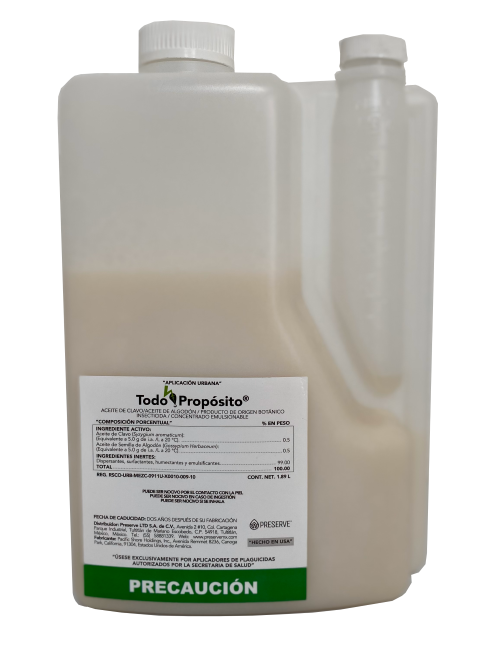
Furthermore, in the United States, it is except from EPA (Environmental Protection Agency) regulation under FIFRA Section 25(b); this is because the EPA has excluded certain pesticides – which pose little to no risk to human health or the environment – from federal registration requirements under the Federal Insecticide, Fungicide, and Rodenticide Act (FIFRA). These are known as FIFRA 25(b) exempt or minimum-risk pesticides.
Help protect yourself and society from illegal pesticides; those who sell, transport, or manufacture illegal pesticides endanger human health and the environment and violate the law. Therefore, you should report such activities to COFEPRIS.
Most popular

How a Glasgow restaurant faced financial disaster due to a lack of attention to pest control.
The Restaurant Disaster Failure to detect a pest...

0 Comments