

Organic fumigation using Modified Atmospheres (MAP) controls insects at ALL stages, without chemical residues.
Why is it called organic fumigation?
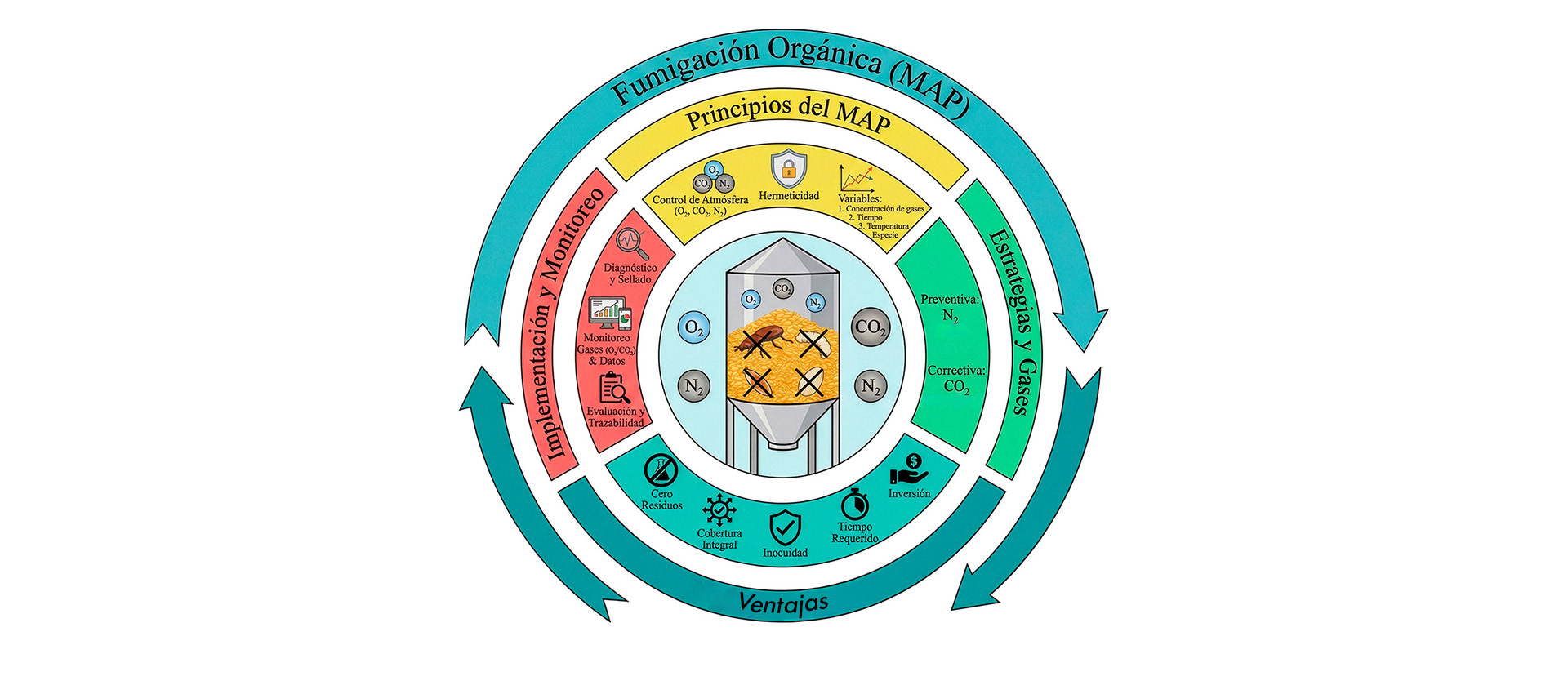
Because organic fumigation using MAP does not rely on insecticides applied directly to stored products; instead, it utilizes a physicochemical method involving naturally occurring gases. In practice, this helps alleviate concerns regarding chemical residues and enhances product safety. However, there is an important distinction: “organic” does not mean “improvised.” Organic fumigation using MAP demands engineering, precise measurement, and evidence-based results.
Organic fumigation using MAP involves controlling the environment within an airtight system by replacing the air with a specific gas mixture tailored to the objective. Nitrogen (N₂) is used for preservation; it displaces oxygen, thereby reducing oxidation, spoilage, and contamination of the stored goods. If insects are present, carbon dioxide (CO₂) is used as a control measure; at the right concentration and duration, it creates an environment in which the pests cannot survive.
Two strategies, one goal
1) Preventive. By purging the space with nitrogen, oxygen levels drop significantly, maintaining a stable atmosphere for weeks or even months. This strategy is ideal for protecting stored products: it halts the biological cycle, reduces the risk of re-infestation, and slows down oxidation processes that affect the product’s organoleptic properties. This type of fumigation is known as bioconservation; it helps preserve product quality for extended periods—for instance, up to 180 days, depending on the product, temperature, and airtightness.
2) Corrective. When a pest infestation is already present, raising carbon dioxide levels (while simultaneously reducing oxygen) accelerates control. Operationally, it acts as a “technical strike” that targets the infestation without leaving chemical residues on the product. Corrective treatment: safe (free of toxic gases) and highly effective, provided the concentration, duration, and system sealing requirements are met.
In summary, both N₂ and CO₂ can safeguard product safety and regulatory compliance if applied correctly. The difference lies in the approach: N₂ is used as a preventive bioconservation strategy to maintain a stable atmosphere over long periods—keeping the product fresh for much longer and reducing re-infestation—whereas CO₂ is used correctively to eliminate insects when a pest is already present and immediate control is required. In both cases, efficacy depends on designing and verifying the treatment by controlling five variables: airtightness, concentration, exposure time, insect species/life stage, and monitoring.
Real advantages
Zero pesticide residues on the product: the treatment consists of a modified atmosphere (N₂/CO₂), not an active ingredient.
- Potential for comprehensive coverage: by maintaining lethal conditions for a sufficient duration, it is possible to control all insect life stages.
- Compatibility with organic certification programs: aligns pest control with documentation and process control requirements.
Modified Atmosphere System
To carry out Organic Fumigation with MAP, vQm vacuum and injection units are used. This state-of-the-art equipment allows for precise adjustment of gas injection speeds, enabling them to be matched with the vacuum cycle speed.
The patented vQm valve head features a completely redesigned structure. The main hose connection prevents unnecessary twisting of the valve and bag, making the operation easier and safer.
The unit features a 4″ touchscreen, stores up to 30 preset programs, and is constructed from stainless steel with CE certification.
The future of organic stored-product pest control lies in superior management; MAP transforms fumigation into a verifiable process offering reduced residues, greater evidence, and protection that begins right where the insect hides—even before you spot it.
Are you interested in this organic fumigation technology?
Most popular

Safeguarding seeds for posterity
The sun is unforgiving outdoors; temperatures do not drop below 33ºC....

Grains as an aid to our Survival
Shelling out a large sum of money at a very expensive restaurant might...
Why eliminate dichlorvos in urban applications?
What is dichlorvos The dichlorvos (DDVP - Dimethyl Dichlorovinyl...

0 Comments